
The End of the Interface: How Zero-UI is Quietly Taking Over Your Life (and Your Business)
We are conditioned to think of technology as something we look at—a screen, an app, a dashboard. But a massive paradigm shift is underway. "Zero-UI" is the concept of technology that anticipates your needs without you ever tapping a screen. From predictive smart homes to automated enterprise data flows, discover how ambient computing is making technology invisible, and how Isaii Technologies is building the architecture for this screen-less future.
By Isaii Team
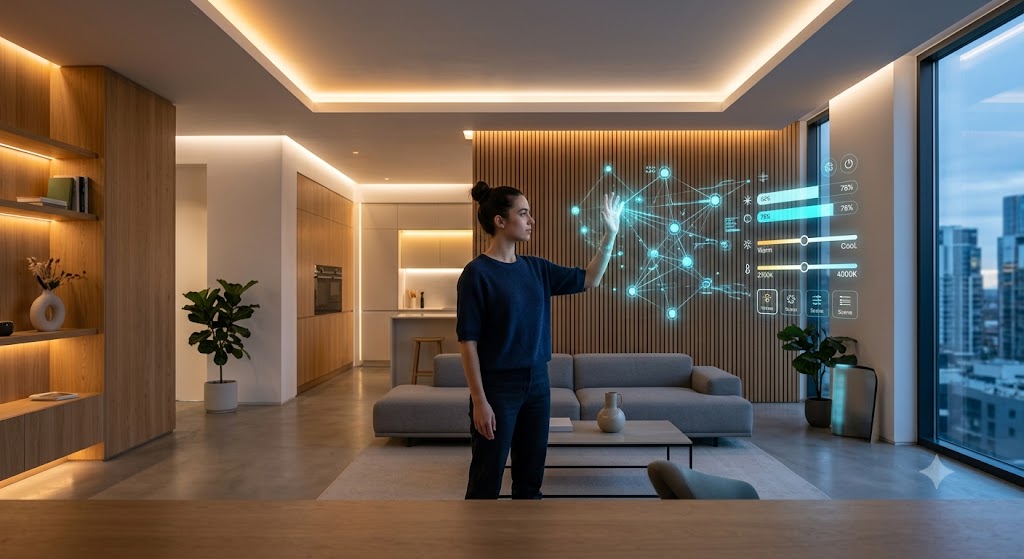
Beyond the Graphical User Interface
For decades, the evolution of technology has been tied to the Graphical User Interface (GUI). We moved from command-line text to desktop icons, and then to the touchscreens that now dominate our lives. For tech enthusiasts who constantly surf for the next big innovation, the focus has often been on "better screens"—higher resolution, faster refresh rates, thinner bezels.
However, a fundamental shift is happening. The future of human-technology interaction isn't a better screen; it is no screen at all. This design philosophy is known as Zero-UI (Zero User Interface).
The goal of Zero-UI is to make interactions with devices and applications so seamless and natural that they become unobtrusive and nearly undetectable. Instead of forcing humans to learn the language of machines (clicking, tapping, navigating menus), Zero-UI uses technologies like natural language processing (NLP), computer vision, and machine learning to force machines to understand the natural language and behavior of humans.
Ambient Computing in Daily Life: The Predictive Home
You might already be experiencing the early stages of Zero-UI without realizing it. Voice assistants like Alexa or Google Assistant are prime examples, allowing you to control environments through natural speech rather than opening an app.
But the true power of Zero-UI lies in Predictive Interaction. Instead of reacting to a command, the technology anticipates your needs based on context.
Consider the concept of geofencing in smart home security. A geofence is a virtual perimeter set up around your home using your smartphone's location data.
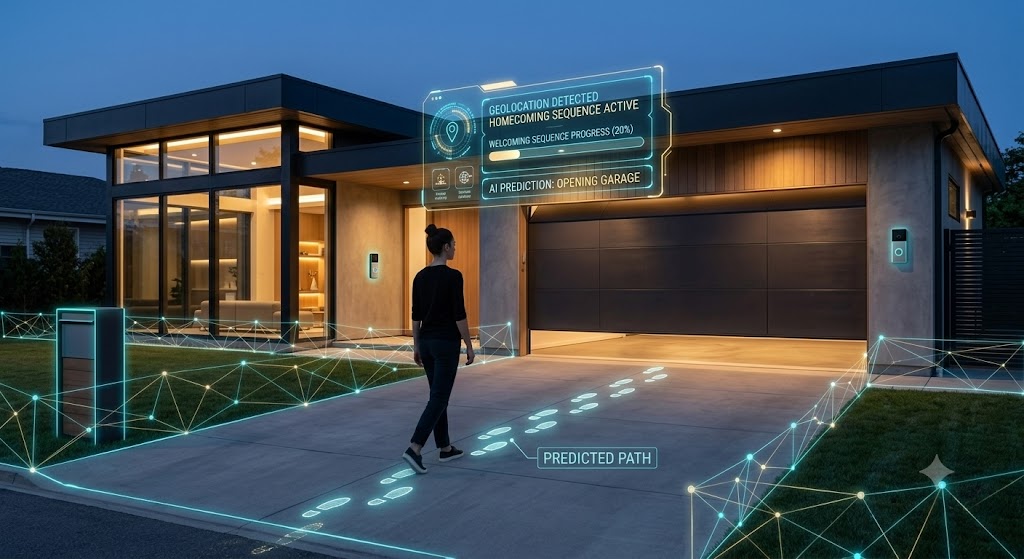
In Zero-UI, there is no need for you to take out your smartphone in order to launch your garage door app or turn off the alarm. As you pass through this digital threshold, the system will automatically unlock the garage doors, turn on the light, and adjust your smart thermostat, because it already knows your behavior and context. Interface (application) disappears from the equation in Zero-UI.
Zero-UI and The Business Application: Streamlined Enterprise Data Flow
Of course, being able to geofence a garage door is nice, but when applied to enterprise architecture, Zero-UI delivers enormous economic value. In business terms, friction means data entry. Employees spend many hours being the interface between various software systems.
In order to deliver Zero-UI experience in business, it is necessary to establish the architecture of the streamlined enterprise data flow. It requires creating pipelines which ingest the data from multiple sources, transform it by applying certain business rules and route the data to its endpoint (sink) without any manual intervention required.
If the system architecture is fragmented (a "Franken-stack"), integration costs a lot of money and often poses a point of failure.
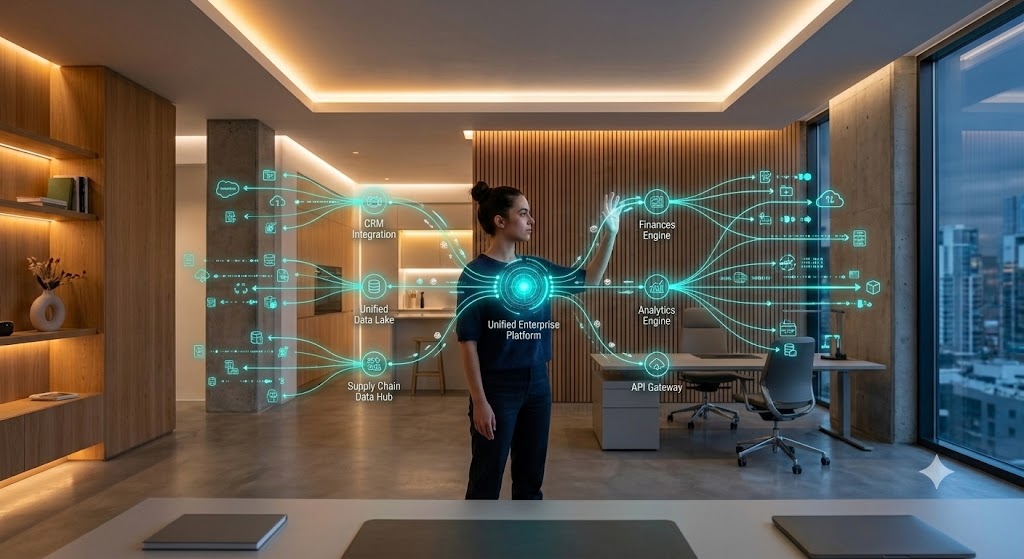
Think about placing an order with a company. In the world of Zero-UI enterprise architecture, the salesperson will not log an order manually, will not check whether the inventory is there, and will not communicate with logistics. The process will run automatically behind the scenes: the inventory will be checked, logistics will be informed about the order, and billing will take place without any user involvement. Thus, your employee can dedicate all his time to communication with the customer rather than working with the computer.
Engineering the Invisible with Isaii Technologies
Zero-UI does not only involve design, but also engineering. Without very reliable backend, the absence of the interface does not work at all if your data and APIs are not working together.
Is this what Isaii Technologies is building for our clients? Absolutely. Using a unified ecosystem such as GRAM Integrated Business Management System, we are able to remove fragmented data silos that require some kind of human intervention. We are creating data flows and custom AI agents that allow your business software to predict your actions and run workflows in the background.
Technology of the future is invisible. Contact Isaii Technologies today to build your own, customized zero-UI.
Next step
Interested in working together?
Tell us about your product or idea — we'd love to hear from you.
Continue reading
More articles
Custom AI Solutions
The Future of AI in Daily Life: Moving Beyond ChatbotsWe are past the initial fascination with public large language models. The next revolution in Artificial Intelligence isn't about better text generation; it's about context-aware, integrated 'Active Workflow Intelligence' that simplifies and anticipates our daily needs, both personally and professionally. Discover how this invisible workforce is moving from sci-fi to seamless implementation.
5 Min Read
Custom AI Solutions
The "Franken-Stack" Trap: Why Scaling Businesses Are Ditching SaaS Spaghetti for Unified EcosystemsBolting together a generic Western CRM, a separate HR tool, and a third-party WhatsApp wrapper using duct-tape integrations creates a fragile, expensive IT nightmare. We explore why enterprise leaders are abandoning these disconnected "Franken-stacks" and migrating to the natively unified architecture of Isaii Technologies.
5 Min Read
Custom AI Solutions
The Future of Productivity: What Every SME in India Needs to Know About Agentic AIForget basic chatbots. Agentic AI is the dawn of autonomous digital employees that take action, not just answer questions. We explore how this technology will reshape small and medium enterprises (SMEs) in India and how to spot the strategic losers in the coming automation race.
5 Min Read